Energy Load Forecasting
A versatile framework for comparative analysis of regression, classification, and deep learning algorithms. This project focuses on predicting building electrical consumption using the Building Data Genome dataset.
Problem Statement
Predicting electrical energy consumption is critical for grid stability and energy efficiency. The goal is to forecast hourly consumption for the Hog_education_Casandra building by correlating energy metrics with environmental factors.
Key Challenges: Handling time-series seasonality, integrating heterogeneous weather data (temperature, cloud cover, wind speed), and feature engineering from frequency-domain transformations.
Solution Design
The framework is built on a Facade Pattern, allowing a unified interface to trigger disparate model types (ARIMA, LSTM, Random Forest).
Feature Engineering
- Temporal Features: Extraction of day of week and month.
- Signal Processing: Fourier Transforms to extract frequency components.
- Statistical Augmentation: Integrated ARIMA and Inverse Fourier Transform outputs as synthetic features for regression models.
Solution Implementation
The project encapsulates Python's major ML/DL libraries (Scikit-Learn, TensorFlow/Keras) into specialized ModelProviders.
Deep Learning Architectures
Multiple architectures are implemented to capture long-range dependencies in energy usage:
- Recurrent Neural Networks (RNN) & LSTM/GRU
- Convolutional Neural Networks (CNN) for pattern recognition
- Encoder-Decoder (ENC_DEC) architectures
Solution Analysis
Regression models are evaluated using standard metrics to determine the best fit for building energy loads.
Preliminary results indicate that LassoCV achieves the highest coefficient of determination () for this specific building dataset.
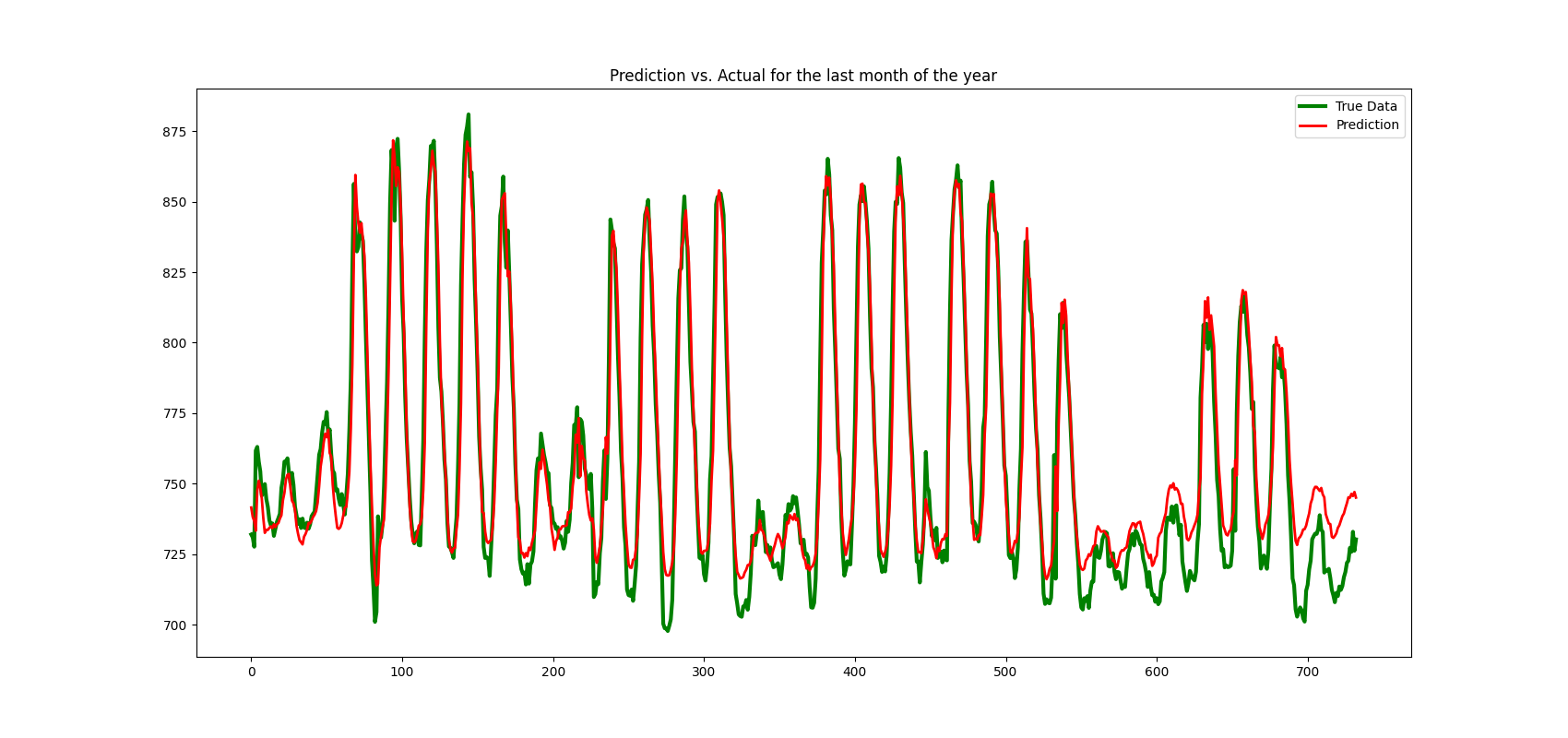
The deep learning phase utilized 17 distinct architectures, ranging from classical MLPs to hybrid Convolutional-LSTM structures. Each model was trained on a 75/25 dataset split using the ADAM optimizer and ReLU activation. To ensure optimal generalization, we implemented an early stopping callback that monitored validation loss, preventing the models from overtraining beyond the point of convergence.
The results highlight a comparative analysis of temporal modeling (RNN, LSTM, GRU), spatial feature extraction (Simple, Multiheaded, and Multichannel CNNs), and complex sequence-to-sequence tasks (Encoder-Decoder frameworks). Specifically, the inclusion of stacked and bidirectional layers allowed for a deeper investigation into how model complexity correlates with Mean Absolute Error reduction across the dataset.
Conclusion
The comparative analysis demonstrates that Deep Learning architectures excel at uncovering intricate, non-linear temporal patterns that traditional methods often overlook. While regularized regression like LassoCV provides a stable baseline for seasonal constraints, the scalability and high-dimensional feature extraction of neural networks represent the most promising path for advancing forecasting precision in complex energy environments.
By integrating Fourier Transforms and ARIMA-derived features, the framework demonstrates that domain-specific feature engineering often provides a more substantial boost to accuracy than model complexity alone. Future work will explore transformer-based attention mechanisms to further refine long-term forecasting reliability.
Source Code
The complete implementation, including the CUDA kernels and the Visual Studio project files, is available on GitHub.