Heat Transfer Simulation
A high-performance C++ simulation leveraging GPU acceleration to model thermal diffusion in a 2D space using the Finite Difference Method.
Problem Statement
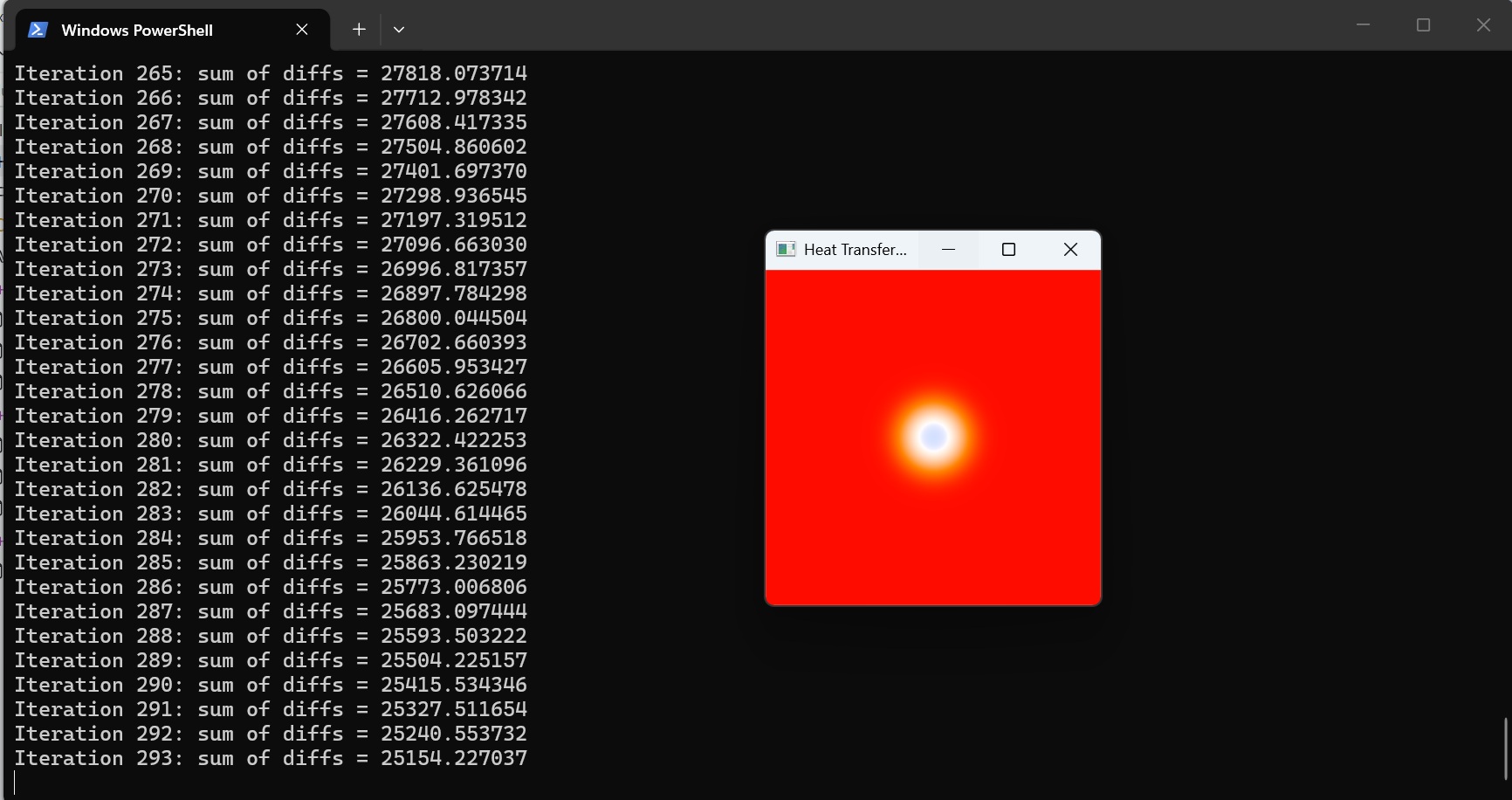
The goal is to simulate 2D transient heat conduction on a conductive metal plate. The simulation models how thermal energy spreads from a constant heat source across a surface until it reaches a state of thermal equilibrium.
Objective: Treat a metal plate as an matrix and calculate the propagation of heat from an initial ambient temperature to a constant heat source at coordinates .
Solution Design
The simulation uses a discrete convolution approach. The temperature of any given point at time is calculated as the average of itself and its eight immediate neighbors (a 3x3 mean filter):
This iterative process continues until Convergence is met: the maximum change in temperature between iterations is less than the specified tolerance :
Solution Implementation
Hardware Acceleration
This application utilizes NVIDIA CUDA for parallel processing. By offloading the mean filter calculations to the GPU, the simulation handles large matrices significantly faster than a CPU-bound approach.
System Requirements
- GPU: NVIDIA CUDA-compatible GPU.
- Software: C++ Development Environment (Visual Studio).
- Dependency: CUDA Toolkit.
Solution Analysis
Performance is primarily bound by two factors:
- Grid Resolution: Larger dimensions increase the memory footprint and calculation time per iteration.
- Iteration Count: Lower tolerance values lead to higher precision but require more cycles to reach equilibrium.
Conclusion
This framework provides a robust starting point for educational thermal modeling. By adjusting parameters, users can observe real-time diffusion patterns and the efficiency of GPU-accelerated numerical methods.
Source Code
The complete implementation, including the CUDA kernels and the Visual Studio project files, is available on GitHub.