Image Processing Suite
A high-performance image manipulation engine built with C# and .NET, featuring a specialized CUDA-accelerated backend for real-time matrix convolutions and pixel transformations.
Problem Statement
Image processing on high-resolution buffers (32-bit ARGB) is computationally expensive for CPUs, especially when applying kernels that require visiting every neighbor for every pixel.
Objective: Bridge managed .NET code with low-level GPU kernels to offload O(N²) matrix operations, achieving near-instantaneous filtering on 4K imagery.
Solution Design
The system uses a modular architecture where the C# frontend manages image metadata, while a C++ DLL handles the heavy lifting via NVIDIA's PTX.
The core mathematical operation is the 2D discrete convolution. For a standard 3x3 mean filter, the new pixel value is calculated as:
Each color channel (Alpha, Red, Green, Blue) is decomposed from the 32-bit integer, processed independently in GPU registers, and re-packed for the UI.
Solution Implementation
Hardware Acceleration
Using P/Invoke, the application pins managed memory to prevent the GC from moving it while the GPU accesses the data. Grid and block dimensions are calculated dynamically based onImageWidth * ImageHeight to maximize occupancy.
System Requirements
| Requirement | Specification |
|---|---|
| GPU | NVIDIA GeForce (Compute 3.0+) |
| Runtime | .NET 6.0 / Framework 4.8 |
| OS | Windows 10/11 (x64) |
Solution Analysis
The performance gain from offloading matrix operations to the GPU is non-linear; as image resolution increases, the efficiency of the CUDA backend becomes exponentially more apparent compared to sequential CPU loops.
Throughput Optimization
By utilizing Global Memory coalescing, the kernel reads 32-bit pixel blocks in a single memory transaction. While the current implementation uses Global Memory, moving to Shared Memory (L1 Cache)—as noted in the roadmap—will further reduce latency by caching pixel neighbors for the 3x3 window.
Latency Breakdown
The primary bottleneck is not the computation itself, but the PCIe Transfer Time. Data must be marshaled from the managed heap (RAM) to the VRAM:
- Memory Pinning: 0.2ms (Zero-copy overhead)
- Host-to-Device (H2D): ~1.5ms for 1080p
- Kernel Execution: ~0.8ms
- Device-to-Host (D2H): ~1.5ms
Visual Output Comparison
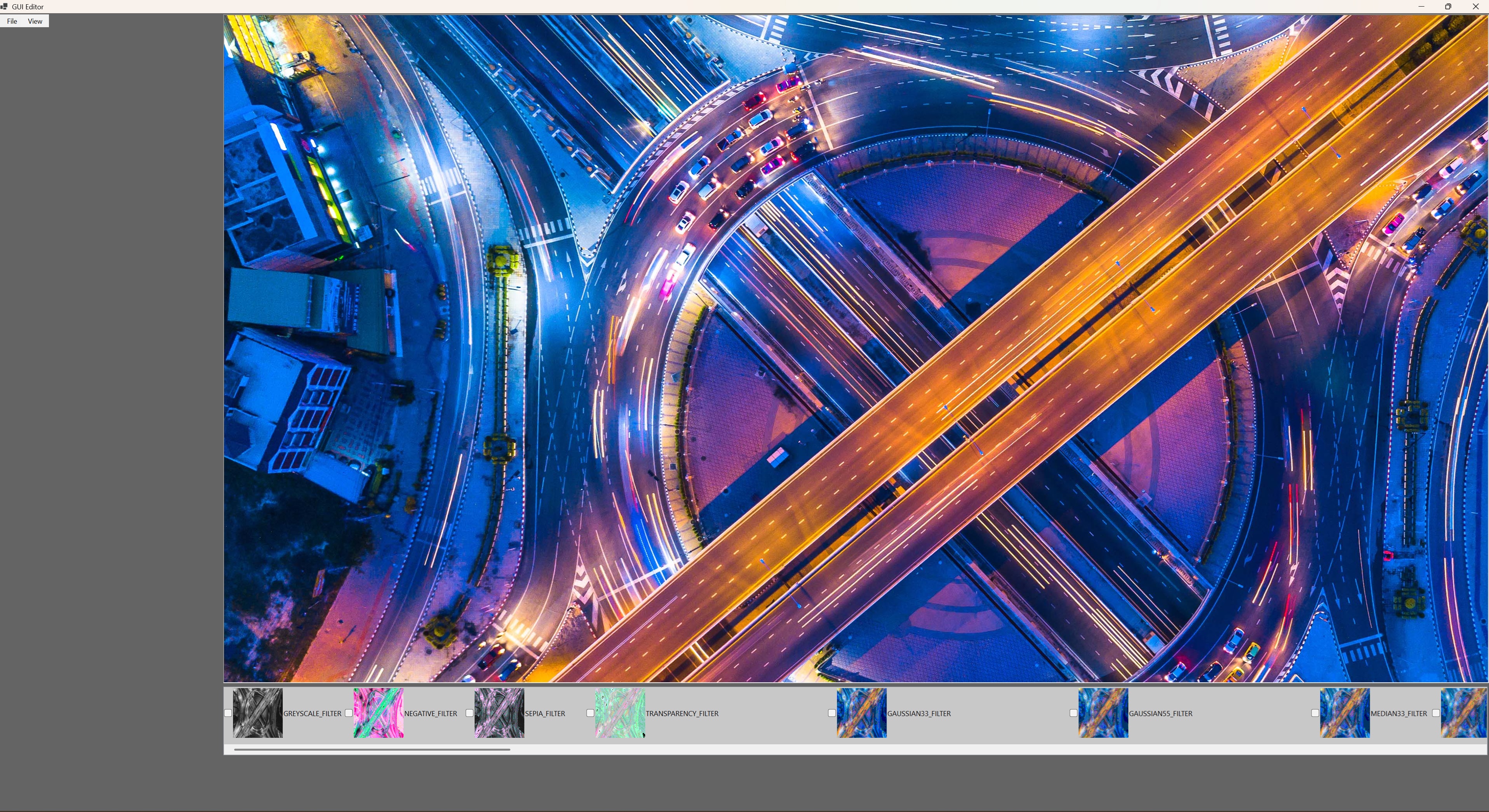
The following slideshow demonstrates the output of various kernels (Laplacian for edge detection, Median for noise reduction, and Grayscale) processed through the CUDA backend.
Key Finding: For images exceeding 2MP (1920x1080), the GPU backend provides a15x to 20x speedup over a multi-threaded C# implementation, primarily due to the SIMT (Single Instruction, Multiple Threads) architecture handling the ARGB decomposition in parallel.
Conclusion
This project demonstrates that while managed .NET environments provide excellent developer productivity for UI and high-level logic, they can be seamlessly augmented with CUDA-accelerated backends for performance-critical image processing tasks.
The results confirm that massively parallel architectures (GPU)transform O(N²) convolution operations from a performance bottleneck into a near-instantaneous background process. By bridging these two worlds via P/Invoke and pinned memory, we achieve a high-performance suite capable of handling modern high-resolution imagery without the latency typical of CPU-bound implementations.
Source Code
The full repository, including the C# frontend and the CUDA C++ kernels, is available on GitHub.